

Detection, Prevalence, and Risk Factors Associated With Vector-Borne Blood Protozoans of Cats in Nineveh Governorate, Iraq
Article Sidebar
Main Article Content
Abstract
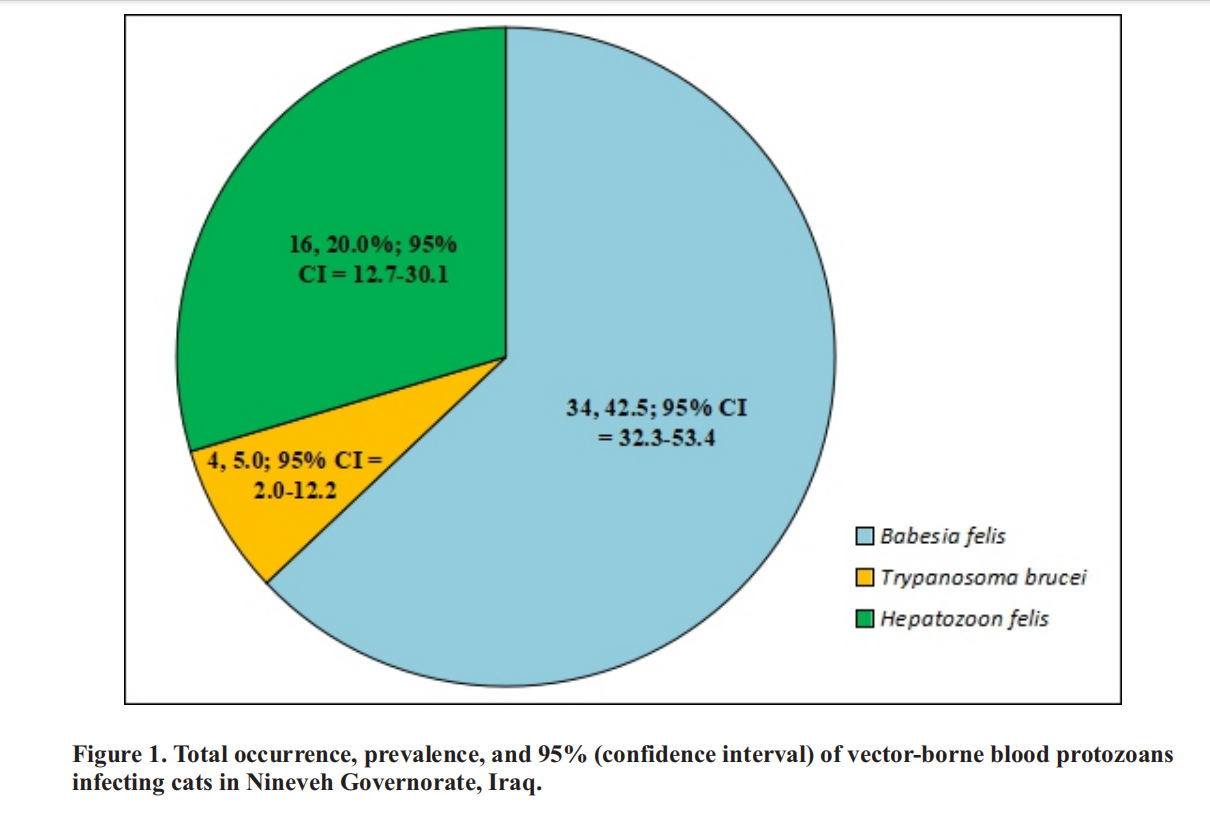
Domestic cats (Felis catus) can be infected with vector-borne pathogens (VBPs) transmitted by biting insects (mosquitoes, flies, ticks, and fleas). Vector-borne pathogens have been documented to sporadically infect cats in various countries worldwide. This study aimed to investigate the presence and epidemiology of vector-borne pathogens in cats in Nineveh Governorate, Iraq. Blood samples were obtained from 80 cats using a 23 g needle from the cephalic vein of each cat. Of these cats, 55 were from private clinics and 25 were from the College of Veterinary Medicine clinics. Age, sex, and breed were recorded accordingly. The blood samples were subjected to parasitological analysis (thin smear and wet mount) and viewed under a microscope. In our study, 54 (67.5%) cats tested positive for blood parasites. Three blood protozoans were detected in cats, with prevalence rates of 42.5%, 20.0%, and 5.0% for Babesia felis, Hepatozoon felis, and Trypanosoma brucei, respectively. Among the private clinic samples, 36 (65.5%) were positive for blood parasites, whereas 18 (72.0%) were positive in the university clinic. Overall, of the 80 cats examined, 34 (42.5%) were positive for B. felis, 4 (5.0%) were positive for T. brucei, and 16 (20.0%) were positive for H. felis. In conclusion, B. felis was the most prevalent blood protozoan infection in cats in this study. Routine surveillance of domestic cats is needed to monitor and control the transmission of vector-borne pathogens.
Article Details

This work is licensed under a Creative Commons Attribution-NonCommercial-NoDerivatives 4.0 International License.
References
Driscoll, C. A., Menotti-Raymond, M., Roca, A. L., Hupe, K., Johnson, W. E., Geffen, E., Harley, E. H., Delibes, M., Pontier, D., Kitchener, A. C., Yamaguchi, N., O’brien, S. J., & Macdonald, D. W. (2007). The Near Eastern origin of cat domestication. Science, 317(5837): 519–523. https://doi.org/10.1126/science.1139518
Driscoll, C. A., Macdonald, D. W., & O’Brien, S. J. (2009). From wild animals to domestic pets: an evolutionary view of domestication. Proceedings of the National Academy of Sciences of the United States of America, 106(1): 9971–9978. https://doi.org/10.1073/pnas.090158610
De la Fuente, J., Antunes, S., Bonnet, S., Cabezas-Cruz, A., Domingos, A. G., Estrada-Peña, A., Johnson, N., Kocan, K. M., Mansfield, K. L., Nijhof, A. M., Papa, A., Rudenko, N., Villar, M., Alberdi, P., Torina, A., Ayllón, N., Vancova, M., Golovchenko, M., Grubhoffer, L., Caracappa, S., Fooks, A. R., Gortazar, C., & Rego, R. O. M. (2017). Tick-pathogen interactions and vector competence: identification of molecular drivers for tick-borne diseases. Frontiers in Cellular and Infection Microbiology, 7: 114. https://doi.org/10.3389/fcimb.2017.00114
Nguyen, V., Colella, V., Greco, G., Fang, F., Nurcahyo, W., Hadi, U., Venturina, V., Tong, K., Tsai, Y., Taweethavonsawat, P., Tiwananthagorn, S., Tangtrongsup, S., Le, T. Q., Bui, K. L., Do, T., Watanabe, M., Abd Rani, P. A. M., Dantas-Torres, F., Halos, L., Beugnet, F., & Otranto, D. (2020). Molecular detection of pathogens in ticks and fleas collected from companion dogs and cats in East and Southeast Asia. Parasites & Vectors, 13: 420. https://doi.org/10.1186/s13071-020-04288-8
Kilpatrick, A. M., & Randolph, S. E. (2012). Drivers, dynamics, and control of emerging vector-borne zoonotic diseases. The Lancet, 380: 1946–1955. https://doi.org/10.1016/S0140-6736(12)61151-9
Otranto, D., & Dantas-Torres, F. (2010). Canine and feline vector-borne diseases in Italy: current situation and perspectives. Parasites & Vectors, 3: 2. https://doi.org/10.1186/1756-3305-3-2
Greco, G., Sazmand, A., Goudarztalejerdi, A., Zolhavarieh, S. M., Decaro, N., Lapsley, W. D., Otranto, D., & Chomel, B. B. (2019). High prevalence of Bartonella sp. in dogs from Hamadan, Iran. American Journal of Tropical Medicine and Hygiene, 101(4): 749–752. https://doi.org/10.4269/ajtmh.19-0345
Alho, A. M., Lima, C., Latrofa, M. S., Colella, V., Ravagnan, S., Capelli, G., de Carvalho, L. M., Cardoso, L., & Otranto, D. (2017). Molecular detection of vector-borne pathogens in dogs and cats from Qatar. Parasites & Vectors, 10: 298. https://doi.org/10.1186/s13071-017-2237-y
Otranto, D., Iatta, R., Baneth, G., Cavalera, M. A., Bianco, A., Parisi, A., Dantas-Torres, F., Colella, V., McMillan-Cole, A. C., & Chomel, B. (2019). High prevalence of vector-borne pathogens in domestic and wild carnivores in Iraq. Acta Tropica, 197: 105058. https://doi.org/10.1016/j.actatropica.2019.105058
Taylor, M. A., Coop, R. L., & Wall, R. (2016). Veterinary Parasitology, 4th Edition. John Wiley & Sons, Inc.
Kelly, P. J., Köster, L., Li, J., Zhang, J., Huang, K., Branford, G. C., Marchi, S., Vandenplas, M., & Wang, C. (2017). Survey of vector-borne agents in feral cats and first report of Babesia gibsoni in cats on St. Kitts, West Indies. BMC Veterinary Research, 13: 331. https://doi.org/10.1186/s12917-017-1230-1
Penzhorn, B. L., Stylianides, E., Coetzee, M. A., Viljoen, J. M., & Lewis, B. D. (1999). A focus of feline babesiosis at Kaapschehoop on the Mpumalanga escarpment. Journal of the South African Veterinary Association, 70(2): 60. https://doi.org/10.4102/jsava.v70i2.755
Hill, D. H. (1955). Trypanosoma brucei in the cat. British Veterinary Journal, 111(2): 77–80. https://doi.org/10.1016/S0007-1935(17)47405-7
Sivajothi, S., & Sudhakara Reddy, B. (2018). Trypanosoma evansi infection in cat—a rare case. Comparative Clinical Pathology, 27(1): 115–116. https://doi.org/10.1007/s00580-017-2560-x
Tarello, W. (2015). Trypanosoma evansi infection in three cats. Revue de Médecine Vétérinaire, 156(3): 133–134.
Mohammed, N. H., Moosa, D. A., & Altaliby, M. A. (2022). Diagnostic study of trypanosomiasis of cats in Mosul, Iraq. Open Veterinary Journal, 12(5): 688–692. https://doi.org/10.5455/OVJ.2022.v12.i5.13
Misra, K. K., Roy, S., & Choudhury, A. (2016). Biology of Trypanosoma (Trypanozoon) evansi in experimental heterologous mammalian host. Journal of Parasitic Diseases, 40(3): 1047–1061. https://doi.org/10.1007/s12639-014-0633-1
Ayllón, T., Diniz, P. P. V., Breitschwerdt, E. B., Villaescusa, A., Rodríguez-Franco, F., & Sainz, A. (2012). Vector-borne diseases in client-owned and stray cats from Madrid, Spain. Vector-Borne and Zoonotic Diseases, 12: 143–150. https://doi.org/10.1089/vbz.2011.0729
Morelli, S., Diakou, A., Traversa, D., Di Gennaro, E., Simonato, G., Colombo, M., Dimzas, D., Grillini, M., Frangipane di Regalbono, A., Beugnet, F., Halos, L., Paoletti, B., & Di Cesare, A. (2021). First record of Hepatozoon spp. in domestic cats in Greece. Ticks and Tick-Borne Diseases, 12(1): 101580. https://doi.org/10.1016/j.ttbdis.2020.101580
Panda, R., Nehra, A. K., Ram, H., Karikalan, M., Garg, R., Nala, R. R., & Pawde, A. M. (2024). Phylogenetic analysis and haplotype networking of Hepatozoon felis infecting wild animals in Gir National Park, Gujarat, India. Parasitology Research, 123(1): 92. https://doi.org/10.1007/s00436-023-08109-6
Abdullah, D. A., Altaee, A. F., Al-Farha, A. A. B., Ali, F. F., Ola-Fadunsin, S. D., & Gimba, F. I. (2023). Serological study of toxoplasmosis in slaughtered animals in Mosul, Iraq. NTU Journal of Agriculture and Veterinary Science, 3(1): 17–23.
Abdullah, D. A., Alobaidii, W. A., Alkateb, Y. N. M., Ali, F. F., Ola-Fadunsin, S. D., & Gimba, F. I. (2023). Molecular detection and prevalence of human-pathogenic Enterocytozoon bieneusi among pet birds in Mosul, Iraq. Comparative Immunology, Microbiology & Infectious Diseases, 95: 101964. https://doi.org/10.1016/j.cimid.2023.101964
Coles, E. H. (1986). Veterinary Clinical Pathology, 4th Edition. W.B. Saunders Company.
Soulsby, E. J. L. (1982). Helminths, Arthropods and Protozoa of Domesticated Animals, 7th Edition. Baillière Tindall.
Thrusfield, M. (2005). Veterinary Epidemiology, 2nd Edition. Blackwell Science Ltd.
Iatta, R., Sazmand, A., Nguyen, V. L., Nemati, F., Ayaz, M. M., Bahiraei, Z., Zafari, S., Giannico, A., Greco, G., Dantas-Torres, F., & Otranto, D. (2021). Vector-borne pathogens in dogs of different regions of Iran and Pakistan. Parasitology Research, 120(12): 4219–4228. https://doi.org/10.1007/s00436-020-06992-x
Muguiro, D. H., Nekouei, O., Lee, K. Y., Hill, F., & Barrs, V. R. (2023). Prevalence of Babesia and Ehrlichia in owned dogs with suspected tick-borne infection in Hong Kong, and risk factors associated with Babesia gibsoni. Preventive Veterinary Medicine, 214: 105908. https://doi.org/10.1016/j.prevetmed.2023.105908
Almendros, A., & Burchell, R. (2021). Multiple complications in a dog infected with Babesia gibsoni. Veterinary Record Case Reports, 9: 126. https://doi.org/10.1002/vrc2.126
Bosman, A. M., Venter, E. H., & Penzhorn, B. L. (2007). Occurrence of Babesia felis and Babesia leo in various wild felid species and domestic cats in Southern Africa. Veterinary Parasitology, 144(1–2): 33–38. https://doi.org/10.1016/j.vetpar.2006.09.025
Jacobson, L., Schoeman, T., & Lobetti, R. (2000). A survey of feline babesiosis in South Africa. Journal of the South African Veterinary Association, 71(4): 222–228. https://doi.org/10.4102/jsava.v71i4.719
Suliman, E. (2009). Detection of Babesia spp., Cytauxzoon felis, and Haemobartonella felis in stray cats in Mosul. Iraqi Journal of Veterinary Sciences, 23(3): 49–55.
Maia, C., Ramos, C., Coimbra, M., Bastos, F., Martins, A., Pinto, P., Nunes, M., Vieira, M. L., Cardoso, L., & Campino, L. (2014). Bacterial and protozoal agents of feline vector-borne diseases in domestic and stray cats from southern Portugal. Parasites & Vectors, 7(1): 1–8. https://doi.org/10.1186/1756-3305-7-115
Penzhorn, B. L., & Oosthuizen, M. C. (2020). Babesia species of domestic cats: Molecular characterisation has opened Pandora’s Box. Frontiers in Veterinary Science, 7: 134. https://doi.org/10.3389/fvets.2020.00134
Yin, F., Mu, D., Tian, Z., Li, D., Ma, X., Wang, J., Guan, G., Yin, H., & Li, F. (2022). Molecular detection of Babesia gibsoni in cats in China. Animals, 12(22): 3066. https://doi.org/10.3390/ani12223066
Colella, V., Nguyen, V. L., Tan, D. Y., Lu, N., Fang, F., Zhijuan, Y., Wang, J., Liu, X., Chen, X., Dong, J., Nurcahyo, W., Hadi, U. K., Venturina, V., Tong, K. B. Y., Tsai, Y. L., Taweethavonsawat, P., Tiwananthagorn, S., Le, T. Q., Bui, K. L., Watanabe, M., Rani, P. A. M. A., Annoscia, G., Beugnet, F., Otranto, D., & Halos, L. (2020). Zoonotic vector-borne pathogens and ectoparasites of dogs and cats in Eastern and Southeast Asia. Emerging Infectious Diseases, 1221–1233. https://doi.org/10.3201/eid2606.191832
Solikhah, T. I., Solikhah, G. P., & Susilo, R. J. K. (2021). Aloe vera and virgin coconut oil (VCO) accelerate healing process in domestic cats (Felis domesticus) suffering from scabies. Iraqi Journal of Veterinary Sciences, 35(4): 699–704.
Eric, D., Hans, D., Tu, W., Duhon, B., Wolfson, W., Balsamo, G., & Herrera, C. (2021). Shelter cats host infections with multiple Trypanosoma cruzi discrete typing units in southern Louisiana. Veterinary Research, 52(1): 53. https://doi.org/10.1186/s13567-021-00923-z
Baneth, G. (2011). Perspectives on canine and feline hepatozoonosis. Veterinary Parasitology, 81(1): 3–11. https://doi.org/10.1016/j.vetpar.2011.04.015
Basso, W., Görner, D., Globokar, M., Keidel, A., & Pantchev, N. (2019). First autochthonous case of clinical Hepatozoon felis infection in a domestic cat in Central Europe. Parasitology International, 72: 101945. https://doi.org/10.1016/j.parint.2019.101945