

Endoparasitic Infection of Pigs Slaughtered for Public Consumption at Two Major Abattoirs in Calabar, Cross River State, Nigeria.
Article Sidebar
Main Article Content
Abstract
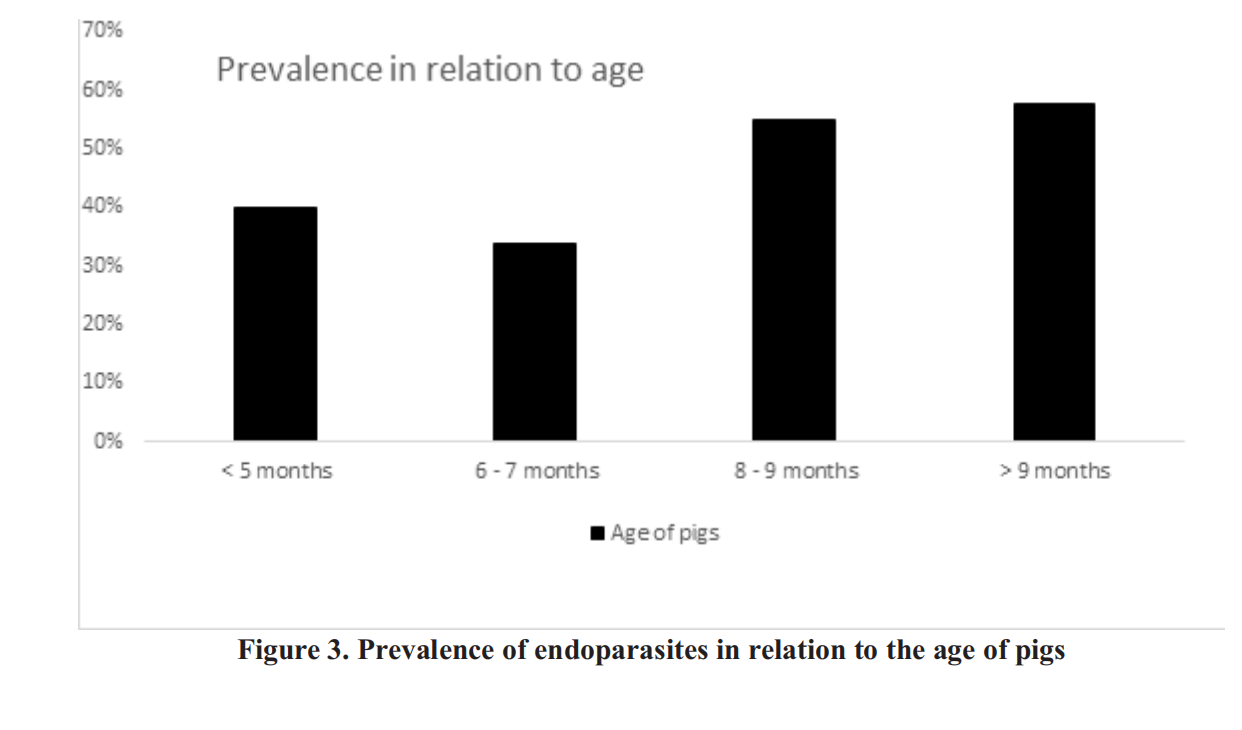
Endoparasites in pigs cause health and production issues. This study aimed to determine the prevalence of endoparasitic infection in pigs slaughtered for public consumption in Calabar, Nigeria, in relation to their veterinary manifestations and body weight. Fresh and about-to-be-voided faecal samples were collected from the rectum of randomly selected 100 pigs, as they were being butchered. Visceral samples were collected hygienically from the same pigs and examined for endoparasites. The overall prevalence of endoparasitic infections was 52.0%. The prevalence was significantly higher among the sows (62.0%) than the boars (42.0%) (χ² = 4.68; p < 0.05) and highest among the oldest age group (≥10 years), with differences among the various age groups being statistically significant (x2= 5.22; p < 0.05). The overall arithmetic mean intensity was 9.5 and was comparable between sexes. Nine endoparasitic species were identified: Ascaris suum, Hystrongylus rubidus, Strongyloides spp., Trichuris suis, Blantidium coli, Oesophagotomum, Fasciola spp., Metastrongylus, and Echinococcus spp. A. suum had the highest prevalence (24.0%), followed by T. suis (10.0%), but the lowest prevalence (2.0%) was by B. coli and H. rubidus, respectively. The overall prevalence of veterinary manifestations was 38.0%. Six veterinary manifestations were observed, but the most common was laboured breathing (12.0%), while the least common was dullness (1.0%). The prevalence of veterinary manifestations was significantly higher in sows than in boars (x2 = 3.94; p < 0.05); it was highest in the least body weight category and in the ≤ 5 months age group, but lowest in the 6 – 7 months age group. Differences in the prevalence of veterinary manifestations were not statistically significant (x2 = 0.981; p > 0.05). In conclusion, endoparasitic infections may be important risk factors for low body weight in pigs. Deworming and biosecurity services should be strengthened, and environmental hygiene and extensive management should be adopted to mitigate the transmission of pig endoparasites.
Article Details

This work is licensed under a Creative Commons Attribution-NonCommercial-NoDerivatives 4.0 International License.
References
Agarwal, S. & Fulgoni, V. L. (2025). Intake of pork is associated with higher nutrient intake and adequacy in race/ethnic population subgroups of adults in the United States. Journal of Food Science and Nutrition Research, 8: 14-23. DOI: 10.26502/jfsnr.2642-110000172.
Adeniyi, I. (2025). Maximising Returns on Investment (ROI) in Pig Farming. https://www.linkedin.com/pulse/maximizing-returns-investment-roi-pig-farming-ife-adeniyi-4rbgf. Accessed May 20, 2025.
Kagira, J. M., Kanyari, P. W. N., Maingi, N., Githigia, S. M., Ng'ang'a, J. C. & Karuga, J. W. (2010). Characteristics of the smallholder free-range pig production system in western Kenya. Tropical Animal Health and Production, 42(5): 865-873. DOI: 10.1007/s11250-009-9500-y.
Dey, T. R., Dey, A. R., Begum, N., & Akther, S. (2014). Prevalence of endoparasites of pigs at Mymensingh, Bangladesh. IOSR Journal of Agriculture and Veterinary Science, 7(4): 31-38. DOI: 10.9790/2380-07433138.
Addy, F., Adu-Bonsu, G., Akurigo, C. A., Abukari, I., Suleman, H., & Quaye, L. (2023). Prevalence of gastrointestinal parasites in pigs: A preliminary study in Tolon and Kumbungu districts, Ghana. Journal of Parasitology Research, 27: 1308329. DOI: 10.1155/2023/1308329.
Omoruyi, Z. & Agbinone, I. (2020). Gastrointestinal parasites among swine bred in Edo State, Nigeria. African Journal of Clinical and Experimental Microbiology, 21(4): 349–353. https://doi.org/10.4314/ajcem.v21i4.12.
Krecek, R. C., Mohammed, H., Michael, L. M., Schantz, P. M., Ntanjana, L., Morey, L., Werre, S. R., & Willingham, A. (2012). Risk factors of porcine cysticercosis in the Eastern Cape Province, South Africa. PLoS ONE, 7(5): e37718. DOI: 10.1371/journal.pone.0037718.
Mwemezi, L. K., Johansen, M. V., Lightowlers, M., Trevisan, C., Uffe, C. B., & Ngowi, H. A. (2023). Aggregation of Taenia solium cysticerci in pigs: Implications for transmission and control. Parasite Epidemiology and Control, 22: e00307. DOI: 10.1016/j.parepi.2023.e00307.
Millogo, A., Njamnshi, A. K., & Luabeya, M. K. (2019). Neurocysticercosis and epilepsy in sub-Saharan Africa. Brain Research Bulletin, 145: 30-38. DOI: 10.1016/j.brainresbull.2018.08.011.
Swai, T. & Lymo, O. (2014). Impact of African Swine Fever epidemics in smallholder pig production units in Rombo district of Kilimanjaro, Tanzania. Livestock Research for Rural Development, 26(2): 63-67. http://www.lrrd.org/lrrd26/2/SWAI26032.html.
Taylor, L. A., Roberto, C., Robin, R. L., Simons, R. L., Simons, P. G., Gale, L. A., & Kelly, L. A. (2020). The risk of infection by African Swine Fever virus in European swine through boar movement and legal trade of pigs. Frontiers in Veterinary Science, 6: 486. DOI: 10.3389/fvets.2019.00486.
Abonyi, F. O. & Njoga, E. O. (2019). Prevalence and determinants of gastrointestinal parasite infection in intensively managed pigs in Nsukka agricultural zone, Southeast Nigeria. Journal of Parasitic Diseases, 44(1): 31-39. DOI: 10.1007/s12639-019-01158-8.
Abiola, J. A. (2018). Public health perspective on the prevalence of intestinal helminths of pigs slaughtered in Ibadan, Oyo State. European Journal of Biological Sciences, 10(1): 25-31. DOI: 10.5829/idosi.ejbs.2018.25.31.
Worldometer (2025). Population by country. https://www.worldometers.info/world-population/population-by-country/
. Accessed May 13, 2025.
Klinsoda, J., Boonsoongnern, B., Thanantong, N., Kaminsonsakul, T., Treesuwan, K., Trevanich, S., & Metzler-Zebeli, B. U. (2025). Microbiome characterisation of edible visceral organs and fresh meat during pig processing. Pathogens, 14(5): 475. DOI: 10.3390/pathogens14050475.
Moravec, F. & Gibbons, L. M. (2010). Keys to the nematode parasites of vertebrates. Parasites & Vectors, 3: 9. https://doi.org/10.1186/1756-3305-3-9.
Masters, B. J., Hamilton, M., & Masters, P. G. (1992). Physical examination of swine. Veterinary Clinics of North America: Food Animal Practice, 8(2): 177-188. DOI: 10.1016/S0749-0720(15)30748-9.
Thanasuwan, S., Piratae, S., Thaowandee, K., & Amporn, C. (2024). Prevalence and diversity of gastrointestinal parasites on pig farms in Kalasin Province, Thailand. Veterinary World, 17(2): 273-281. DOI: 10.14202/vetworld.2024.273-281.
Larbi, J. A., Addo, S. O., Ofosu-Amoako, G., Offong, U. C., Odurah, E. M., & Akompong, S. K. (2022). Burdens of Ascaris spp. and Cryptosporidium spp. parasites in farm pigs in Ghana. Veterinary Medicine and Science, 8(3): 1119-1125. DOI: 10.1002/vms3.756.
Moravec, F. & Gibbons, L. M. (2010). Keys to the nematode parasites of vertebrates. Parasites & Vectors, 3: 9. https://doi.org/10.1186/1756-3305-3-9.
Innocent, I. G., Jimadu, A., Yilleng, C. G., Gomwos, N. P., Dacob, D. D., Bugamma, S. I., & Rengshwat, L. E. (2025). Prevalence of intestinal parasites among farmers in Makurdi Local Government Area of Benue State, Nigeria. South Asian Journal of Parasitology, 8(2): 142–148. DOI: 10.9734/sajp/2025/v8i2221.
Aiyedun, J. & Oludairo, O. (2016). Prevalence of intestinal parasitism of swine in a North Central State of Nigeria. Journal of Advanced Veterinary and Animal Research, 3(3): 278-281. DOI: 10.5455/javar.2016.c163.
Omoruyi, Z. & Agbinone, I. (2020). Gastrointestinal parasites among swine bred in Edo State, Nigeria. African Journal of Clinical and Experimental Microbiology, 21(4): 349–353. https://doi.org/10.4314/ajcem.v21i4.12.
Oluwabiyi, B. (2021). Prevalence of endoparasites in pigs slaughtered for consumption in Ijebu-Igbo, Ogun State. Journal of Entomology and Zoology Studies, 9(4): 54-56. https://www.entomoljournal.com/archives/2021/vol9issue4/PartA/9-4-5-336.pdf.
Amuta, E. U., Houmsou, R. S., & Amuta, P. O. (2015). Gastrointestinal parasites of swine under small-scale management in Makurdi, Benue State, Nigeria. Nigerian Journal of Parasitology, 36(1): 67-71. https://doi.org/10.4314/njpar.v36i1.
Ohaeri, C. & Okoro, C. T. (2012). Gastrointestinal parasites of pigs in a commercial farm in Abia State, Nigeria. Nigerian Journal of Parasitology, 33(1): 63-66. https://doi.org/10.4314/njpar.v33i1.
Bernard, S. N., Njoga, E. O., Abonyi, F. O., Nnadi, P. A., Ozioko, E. I., & Ugwuoke, C. U. (2021). Epidemiology of gastrointestinal worm infections in pigs in Enugu State, Nigeria. Journal of Parasitic Diseases, 45(4): 912–920. https://doi.org/10.1007/s12639-021-01377-y.
Geresu, M. A., Hailemariam, Z., Mamo, G., Tafa, M., & Megersa, M. (2015). Prevalence and risk factors of gastrointestinal parasites of pigs in Ethiopia. Veterinary Science and Technology, 6(4): 1–8. DOI: 10.4172/2157-7579.1000244.
Sowemimo, O. A., Asaolu, S. O., & Adegoke, F. O. (2012). Epidemiological survey of gastrointestinal parasites of pigs in Ibadan, Nigeria. Journal of Public Health and Epidemiology, 4(10): 294-298. DOI: 10.5897/JPHE12.042.
Akanni, O. N., Kingsley, C. A., Frank, M. C., & Jatau, J. D. (2017). Prevalence of gastrointestinal parasites in pigs in Plateau State, Nigeria. Haya: The Saudi Journal of Life Sciences, 2(5): 140–142. DOI: 10.21276/haya.
Atoyebi, T. J., Okorafor, U. P., Unigwe, C. R., & Okorafor, J. C. (2014). Survey of gastrointestinal parasites of pigs at Bodija Abattoir, Ibadan, Nigeria. International Journal of Pure and Applied Sciences and Technology, 20(2): 53-57.
Obisike, V. U., Amuta, P. O., & Iorkyase, S. S. (2018). Epidemiological survey of gastrointestinal parasites of pigs in Makurdi, Benue State. Asian Journal of Advanced Agricultural Research, 5: 1–9. DOI: 10.9734/AJAAR/2018/38928.
Onunkwo, J. I., Njoga, E. O., Nwanta, J. A., Shoyinka, S. V. O., Onyenwe, I. W., & Eze, J. I. (2011). Serological survey of porcine Brucella infection in Southeast Nigeria. Nigerian Veterinary Journal, 32: 60-62. https://doi.org/10.14202/vetworld.2018.1171-1178.
Tidi, S. K. & Ella, F. A. (2011). Prevalence of gastrointestinal parasites of pigs in Jos, Plateau State, Nigeria. Nigerian Journal of Parasitology, 32(1): 37-40. https://doi.org/10.4314/njpar.v32i1.
Balicka-Ramisz, A., Wiśniewski, J., & Stadnytska, O. (2019). Intestinal parasite infections in pigs in different farm systems. Acta Scientiarum Polonorum Zootechnica, 18(4): 47–50. DOI: 10.21005/asp.2019.18.4.06.
Abonyi, F. O. & Njoga, E. O. (2020). Prevalence and determinants of gastrointestinal parasite infection in pigs in Nsukka, Nigeria. Journal of Parasitic Diseases, 44(1): 31–39. https://doi.org/10.1007/s12639-019-01158-8.
Asaolu, S. O. & Ofoezie, I. E. (2018). Ascaris spp. In: Global Water Pathogen Project. https://doi.org/10.14321/waterpathogens41
. Accessed May 4, 2025.
Adenaike, E. A. (2020). Assessment of helminth parasites of pigs in Ibadan, Nigeria. Nigerian Journal of Animal Production, 47(3): 28–33. https://doi.org/10.51791/njap.v47i3.132.
Kipper, M., Andretta, I., Monteiro, S. G., Lovatto, P. A., & Lehnen, C. R. (2011). Meta-analysis of effects of endoparasites on pig performance. Veterinary Parasitology, 181(2–4): 316–320. DOI: 10.1016/j.vetpar.2011.04.029.
Nwafor, I. C., Roberts, H., & Fourie, P. (2019). Prevalence of gastrointestinal helminths in smallholder pigs in Free State Province. Onderstepoort Journal of Veterinary Research, 86(1): e1-e8. DOI: 10.4102/ojvr.v86i1.1687.