

Prevalence of Urogenital Schistosomiasis: Intensity of Eggs and Associated Risk Factors among Primary Schools Children in the Riverine Communities of Taraba State, Nigeria
Article Sidebar
Main Article Content
Abstract
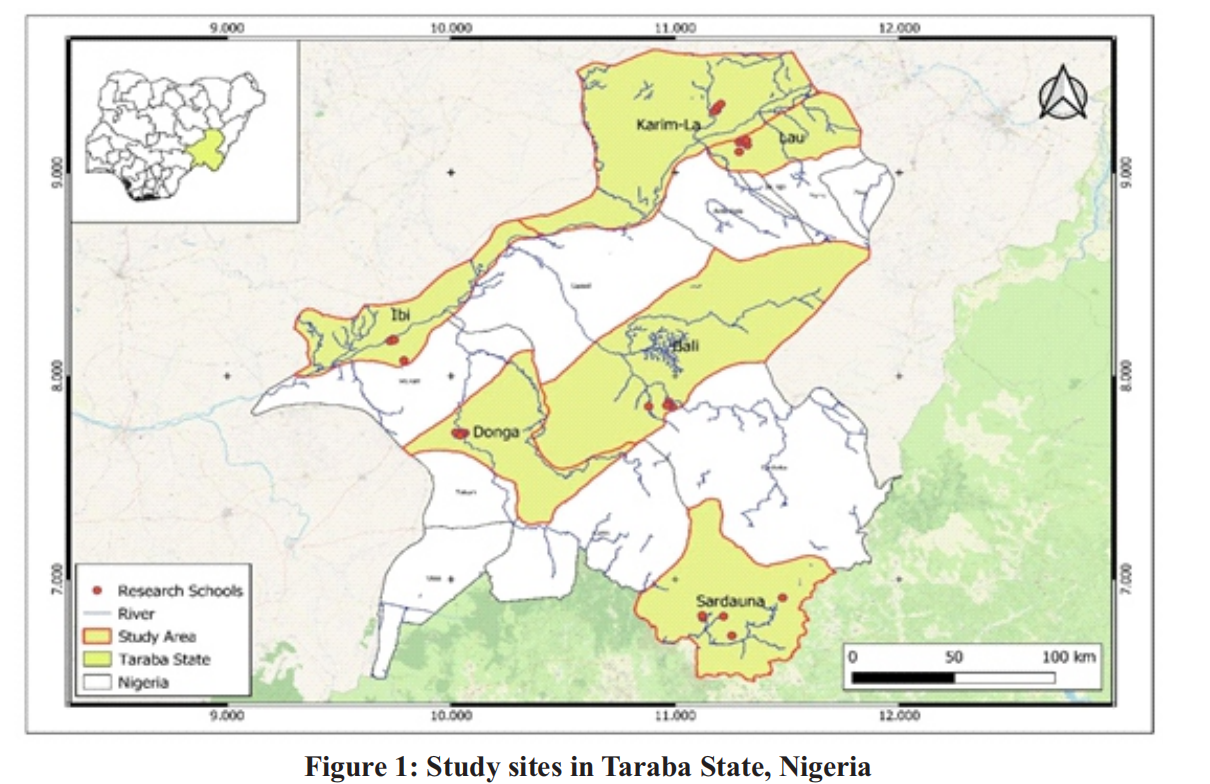
Schistosomiasis remains a major public health challenge in many parts of sub-Saharan Africa, particularly in riverine communities where exposure to infested water is common. Despite control efforts, this disease continues to affect school-aged children and leads to significant morbidity. This study investigated the prevalence of urogenital schistosomiasis, egg intensity, and associated risk factors among primary school children in the riverine communities of Taraba State, Nigeria. A cross-sectional survey was conducted in Bali, Donga, Ibi, Lau, Karim-Lamido, and Sardauna Local Government Areas (LGAs). Urine samples were collected from primary school children and examined via. Chi-square and multinomial logistic regression tests were used to determine statistical significance at P. Of the 1,373 primary school children, 7.9% (108/1,373) were observed. The highest infection rate was observed in Bali LGA (13.1%, 30/228), whereas Lau LGArecorded the lowest infection rate of 3.5% (8/226) (χ² = 14.82, p = 0.002). Age-specific prevalence showed that children aged 13–17 years had the highest infection rate (9.3%, 25/269), followed by those aged 8–12 years (7.6%, 74/980), whereas the lowest prevalence was found among children aged 3–7 years (7.3%, 9/124) (χ² = 10.46, p = 0.015). A significant variation in prevalence was also observed across the schools (χ² = 74.49, p=0.0023). Lau LGAhad the highest intensity of light infection, 100% (8/8), while Karim-Lamido had the highest intensity of heavy infection of eggs, 44.4% (8/14) (χ2 = 12.805; p≤0.05). Pupils who went fishing were exposed to urogenital schistosomiasis with an adjusted Odds Ratio (aOR) of 2.11; 95% CI: 1.18-3.76, p=0.011), as well as swimming and bathing (aOR=2.32; 95% CI: 1.14-4.72; p=0.019), and swimming and fishing (aOR=2.01; 95% CI: 1.20-3.36; p=0.008). Pupils who used to go playing in ponds/rivers and those who used to go washing were also exposed to the infection (aOR=3.43; 95% CI: 1.56-7.53; p=0.002) and(aOR=3.61; 95% CI: 1.78-7.33), respectively. Urogenital schistosomiasis shows low endemicity among school-aged children in the riverine communities of Taraba State, Nigeria. The highest infection rate was recorded in Bali among children aged 13-17 years old. Therefore, control programs should prioritise the provision of clean water, health education, and target interventions in high-risk areas to reduce the transmission and morbidity among children.
Article Details

This work is licensed under a Creative Commons Attribution-NonCommercial-NoDerivatives 4.0 International License.
References
World Health Organisation. (2024). Schistosomiasis: Key facts. World Health Organisation. https://www.who.int/news-room/fact-sheets/detail/schistosomiasis. Accessed on 22/07/2025.
Steinmann, P., Keiser, J., Bos, R., Tanner, M., & Utzinger, J. (2006). Schistosomiasis and water resources development: Systematic review, meta-analysis, and estimates of people at risk. The Lancet Infectious Diseases, 6(7), 411–425. https://doi.org/10.1016/S1473-3099(06)70521-7.
Houmsou, R. S., Wama, E. B., Hemen A., Uniga, J. A., Bingbeng, J. B., Jerry, T. J., Azuaga, P., Amuta, E. U., & Kela, S. L. (2021). Integrated control of river and pond water as an exposure source to urogenital schistosomiasis of rural inhabitants in southern Taraba State, Nigeria. Journal of Water, Sanitation and Hygiene for Development, 11(4): 546-557. https://doi:10.2166/washdev.2021.257/881395.
Colley, D. G., Bustinduy, A. L., Secor, W. E., & King, C. H. (2014). Human schistosomiasis. The Lancet, 383(9936), 2253–2264. https://doi.org/10.1016/S0140-6736(13)61949-2.
Hotez, P. J., Kamath, A., Fenwick, A., & Bustinduy, A. (2012). Nigeria: “Ground zero” for the high prevalence of neglected tropical diseases. PLoS Neglected Tropical Diseases, 6(7), e1600. https://doi.org/10.1371/journal.pntd.0001600.
Global Network Neglected Tropical Diseases. (2015). Nigeria: Country profile on neglected tropical diseases. Global Network for Neglected Tropical Diseases. https://www.neglecteddiseases.gov.
Bishop, H. (2017). Epidemiology of schistosomiasis in Nigeria: Current Status and perspectives. Journal of Parasitology Research. https://doi.org/10.1155/2017/30482908
Houmsou, R. S., Agere H., Wama B. E., Bingbeng J. B., Amuta E. U., & Kela S. L. (2016). Urinary schistosomiasis among children in Murbai and Surbai Communities of Ardo-kola Local Government Area, Taraba State, Nigeria. Journal of Tropical Medicine, 9831265. https://doi:10.1155/2016/9831265. Epub 2016 Dec 14. PMID: 28096819; PMCID: PMC5206853.
Wama, B. E., Bala, A. Y., & Abdullahi, K. (2022). Epidemiology of urinary schistosomiasis among school-aged children in Taraba State, Nigeria. Nigerian Journal of Parasitology, 43(1), 45–52. https://doi.org/10.4314/njpar.v43i1.5
Elijah, M., Lamidi, T., Francis, I. & Mohammad, S. (2014). Investigating Urinary Schistosomiasis in Bali Town, Bali Local Government Area, Taraba State, Nigeria. Nigerian Journal of Parasitology, 35(172): 1117- 4145 https://www.ajol.info/index.php/njpar/article/view/110696.
French, M. D., Churcher, T. S., Basáñez, M. G., Norton, A. J., & Lwambo, N. J. S. (2007). Evaluation of the global strategy for schistosomiasis and soil-transmitted helminthiasis: Treatment and control. Parasitology, 134(11), 1539–1549. https://doi.org/10.1017/S0031182007004845.
Akogun, O. B. (1999). Schistosomiasis in Nigeria: Epidemiology and control. Acta Tropica, 73(2), 219–224. https://doi.org/10.1016/S0001-706X(99)00023-3
Barau, C. B., Anzaku, S. A., Adamu, S. H., & Adejoh, V. A. (2020). Schistosomiasis in Taraba State: Prevalence, intensity and risk factors among school children. Nigerian Journal of Parasitology, 41(1), 1–8. https://doi.org/10.4314/njpar.v41i1.1
Singh K., Muddasiru, D., & Singh J. (2016). Current status of schistosomiasis in Sokoto, Nigeria. Parasite Epidemiology & Control. 1(3):239–244. doi: 10.1016/j.parepi.2016.08.003.
World Health Organisation. (2002). Prevention and control of schistosomiasis and soil-transmitted helminthiasis: Report of a WHO expert committee (WHO Technical Report Series No. 912). World Health Organisation. https://apps.who.int/iris/handle/10665/42588
. Accessed on 24/07/2025.
Francisca, N. A., Johnson, H. K., & Peter, I. O. (2022). Mesoendemicity of Schistosoma haematobium infection in Takum Local Government Area, Taraba State, Nigeria. Journal of Helminthology, 96(e68), 1–8. https://doi.org/10.1017/S0022149X22000567.
Agumah N., Opara J., Odoemena O., Mbamalu C., Oru C., & Chukwu M. (2019). Incidence of urinary schistosomiasis among school children in a community in Ebonyi State, south-east Nigeria. Nigerian Journal of Parasitology, 40(2), 215-217. https://doi.org/10.4314/njpar.v40i2.17.
Mathew, Y., Wilson, A., Abdullahi, M., & Saidu, A. (2025). Soil Transmitted Helminths and Schistosomiasis in Adamawa Northern Senatorial District, Nigeria. African Multidisciplinary Journal of Sciences and Artificial Intelligence, 2(2), 174-194. https://doi.org/10.58578/amjsai.v2i2.5328.
Uweh, P. O., Omudu, E. A., & Onah, I. E. (2015). Current Status of Schistosomiasis amongst School Children in Igedeland, Benue State, Nigeria. Nigerian Annals of Pure and Applied Sciences, 6. 16-21. https://dio.org/10.46912/napas.3.
Ogunniyi, A., James, E., & Adewale, A. (2021). Variations in schistosomiasis prevalence across communities in Nasarawa State, Nigeria: The role of agriculture and water contact practices. Journal of Parasitology Research, 2021, 1–9. https://doi.org/10.1155/2021/8845312.
Nwoke, B. E. B., Okafor, F. C., & Onwuliri, C. O. E. (2022). Human schistosomiasis in sub-Saharan Africa: Environmental and behavioural determinants. Journal of Parasitic Diseases, 46(4), 987–995. https://doi.org/10.1007/s12639-022-01518-5.
Ogunyemi, A. O., Salawu, S. A., & Bello, O. A. (2021). Water contact activities and schistosomiasis risk in rural Nigerian communities.BMC Public Health, 21(1), 1593. https://doi.org/10.1186/s12889-021-11642-1.