

A Survey of Female Genital Schistosomiasis, Clinical Manifestations, and Socio-economic Risk Factors Associated with Females of Reproductive Age in Two Selected Local Government Areas in Kaduna State, Nigeria
Article Sidebar
Main Article Content
Abstract
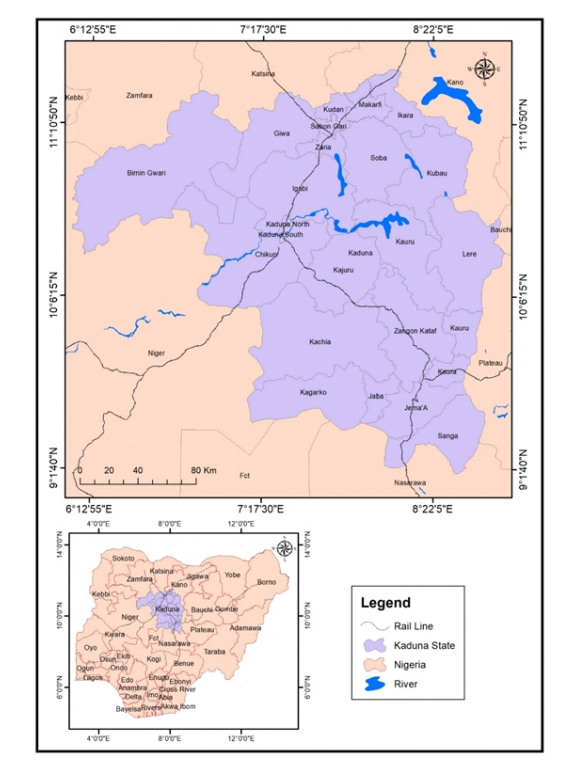
Female Genital Schistosomiasis (FGS) is a neglected tropical disease caused by Schistosoma haematobium, which is transmitted through contact with infested freshwater. FGS symptoms include vaginal discharge, itching, dysuria, and dyspareunia, which can mimic sexually transmitted infections. It disproportionately affects women in rural sub-Saharan Africa, particularly in Northern Nigeria, where access to clean water and healthcare is limited. Across-sectional study was conducted in four communities in Igabi and Jama’a Local Government Areas (LGAs) of Kaduna State, Nigeria. Purposive sampling was employed, focusing on women aged 15–40 years. Urine samples were analysed using physical, chemical, and parasitological methods. Clinical examination of the cervix was performed to identify the characteristic lesions of FGS. Asso community in Jama’a LGA recorded the highest perception of multiple symptoms at 30%, while Zangon Aya community in Igabi LGA recorded the least, 02%. Urinalysis results revealed two local governments with positive socio-economic risk factors cases of Schistosoma haematobium: Gadan Gaya (2.3%) and Igabi (5.7%), accounting for 1.9% of positive cases from the total number of subjects investigated, with haematuria detected in 24 samples, representing 11.1% of the specimens. Of the 200 women examined, 27% in Igabi and 22% in Jama’a LGA tested positive for FGS via cervical examination. Grainy sandy patches and rubbery papules were observed among participants in Igabi and Jama’a, 32% and 34%, respectively. Participants aged 15–19 had the highest infection rate at 27.5%, while 20 -24 had the lowest at 20.5%. Water sources were pipe-borne (64%), rivers (11%), and streams (20%), with 43.5% of respondents not treating water before use. Awareness of FGS symptoms was low, with only 15.5% of respondents recognising genital itching as a concern. This study confirmed the prevalence of FGS in Kaduna State, Nigeria. Recommendations include integrating FGS screening into reproductive health services, increasing community sensitisation.
Article Details

This work is licensed under a Creative Commons Attribution-NonCommercial-NoDerivatives 4.0 International License.
References
World Health Organization. (2021). Female genital schistosomiasis: A silent threat to women’s health and gender equality. https://espen.afro.who.int/female-genital-schistosomiasis-silent-threat-womens-health-and-gender-equality
World Health Organization. (2021). Schistosomiasis: Genital manifestations. https://www.who.int/news-room/fact-sheets/detail/schistosomiasis
Ibrahim, R., Farouk, H. U., Yakubu, A., Lawan, A. I., Azeez, O. A., Emmanuel, O., & Baba, M. G. (2023). Clinical manifestations of female genital schistosomiasis in Zamfarawa community of Gombe State, Northeastern Nigeria. Journal of the Epidemiological Society of Nigeria, 6(1), 107–115. https://doi.org/10.5281/zenodo.8287795
Abovegodwin, G., Badaki, J., Ngwamah, J., Atawodi, J., & Umar, V. (2025). Prevalence of female genital schistosomiasis among fishing communities in North Central Nigeria. Direct Research Journal of Public Health and Environmental Technology, 9(1), 11–18. https://www.ajol.info/index.php/drjphet/article/view/300688
Al-Amin, M. A., & Dadan-Garba, A. (2014). Urban vegetation study of Kaduna metropolis using GIS and remotely sensed data. Journal of Natural Sciences Research, 4(2), 2224–3186. https://www.iiste.org/Journals/index.php/JNSR/article/viewFile/10741/10967
Yamane, T. (1967). Statistics: An Introductory Analysis (2nd ed.). Harper and Row.
Diab, R. G., Tolba, M. M., Ghazala, R. A., Abu-Sheasha, G. A., Webster, B. L., & Mady, R. F. (2021). Intestinal schistosomiasis: Can a urine sample decide the infection? Parasitology International, 80, 102201. https://doi.org/10.1016/j.parint.2020.102201
Sobrino-Vegas, P., et al. (2011). The Spanish HIV Research Network cohort. Enfermedades Infecciosas y Microbiología Clínica, 29(9), 645–653. https://doi.org/10.1016/j.eimc.2011.06.002
Shimizu, K., et al. (2011). Altered gut flora and septic complications. Digestive Diseases and Sciences, 56(4), 1171–1177. https://doi.org/10.1007/s10620-010-1418-8
Vinkeles Melchers, N. V. S., et al. (2014). Diagnostic performance of Schistosoma PCR in urine. PLoS Neglected Tropical Diseases, 8(4). https://doi.org/10.1371/journal.pntd.0002807
Ruantip, S., et al. (2021). Urine IgG variation in strongyloidiasis diagnosis. Acta Tropica, 218, 105896. https://doi.org/10.1016/j.actatropica.2021.105896
Ridley, J. W. (2018). Procedures for complete urinalysis. In Fundamentals of the Study of Urine and Body Fluids (pp. 203–249). Springer. https://doi.org/10.1007/978-3-319-78417-5_10
Kavuru, V., et al. (2020). Dipstick urine analysis. Postgraduate Medicine, 132(3), 225–233. https://doi.org/10.1080/00325481.2019.1679540
Clark, W. F., et al. (2011). Urine volume and kidney function. Clinical Journal of the American Society of Nephrology, 6(11), 2634–2641. https://doi.org/10.2215/CJN.01990211
Zhang, N., et al. (2017). Urine colour and dehydration. Asia Pacific Journal of Clinical Nutrition, 26(5), 788–793. https://doi.org/10.6133/apjcn.052017.09
Mbonu, C. C., et al. (2022). Urine turbidity review. In Bioenergy and Biochemical Processing Technologies. Springer. https://doi.org/10.1007/978-3-030-96721-5_22
Adegoke, O. A., & Ibitoye, B. O. (2018). Urinalysis in clinical diagnostics. African Journal of Laboratory Medicine, 7(1), 1–8. https://doi.org/10.4102/ajlm.v7i1.734
Sow, S., et al. (2003). Water contact and schistosomiasis transmission. Tropical Medicine & International Health, 8(12), 1005–1015. https://doi.org/10.1046/j.1365-3156.2003.01129.x
Bishop, H. G., et al. (2024). Urogenital schistosomiasis in school children. Science World Journal, 19(1), 151–154. https://doi.org/10.4314/swj.v19i1.20
Kanwai, S., et al. (2012). Schistosoma haematobium risk factors. Science World Journal, 6(2), 15–19. https://doi.org/10.4314/swj.v6i2
World Health Organization. (2023). Schistosomiasis: Progress report 2022. https://www.who.int/publications/i/item/who-wer9851-667-676
Ekeleme, U., & Sampson, M. (2025). Risk factors of schistosomiasis in Nigeria. SSRN. https://doi.org/10.2139/ssrn.5417884
Sady, H., et al. (2023). Epidemiology of schistosomiasis. Global Health Action, 16(1), 2174581.
Hotez, P. J., et al. (2019). Female genital schistosomiasis and HIV. PLoS Neglected Tropical Diseases, 13(4), e0007025. https://doi.org/10.1371/journal.pntd.0007025
Ugbomoiko, U. S., et al. (2021). Schistosomiasis and hygiene practices. Transactions of the Royal Society of Tropical Medicine and Hygiene, 115(4), 367–375. https://doi.org/10.1179/136485910X12743554760469
Kjetland, E. F., et al. (2008). Female genital schistosomiasis clinical indicators. Tropical Medicine & International Health, 13(12), 1509–1517. https://doi.org/10.1111/j.1365-3156.2008.02161.x
Jourdan, P. M., et al. (2011). Schistosoma infection and HIV target cells. American Journal of Tropical Medicine and Hygiene, 85(6), 1060–1064. https://doi.org/10.4269/ajtmh.2011.11-0135
UNICEF. (2023). WASH in Nigeria. https://www.unicef.org/nigeria/water-sanitation-and-hygiene
Ekpo, U. F., et al. (2017). Female genital schistosomiasis in Nigeria. Parasitology Open, 3(10), 1–9. https://doi.org/10.1017/pao.2017.11
Bature, E., et al. (2022). Female genital schistosomiasis in Abuja. American Journal of Science, Engineering and Technology, 7(2), 44–49. https://doi.org/10.11648/j.ajset.20220702.13
ESPEN. (2024). Female genital schistosomiasis overview. https://espen.afro.who.int/female-genital-schistosomiasis-silent-threat-womens-health-and-gender-equality
WHO. (2021). Schistosomiasis treatment progress report. https://www.who.int/news/item/08-12-2017-schistosomiasis-who-reports-substantial-treatment-progress-for-school-age-children
Kayuni, S., et al. (2019). Male genital schistosomiasis review. Parasite Epidemiology and Control, 4, e00077. https://doi.org/10.1016/j.parepi.2018.e00077
Ekpo, U. F., et al. (2017). Urogenital schistosomiasis in preschool children. Parasites & Vectors, 10, 85. https://doi.org/10.1186/1756-3305-3-58
Rossi, B., et al. (2024). Female genital schistosomiasis review. Microorganisms, 12(3), 458. https://doi.org/10.3390/microorganisms12030458
Yirenya-Tawiah, D. R., et al. (2016). Knowledge of schistosomiasis in Ghana. Reproductive Health, 13, 117. https://doi.org/10.1186/s12978-016-0238-5
Gallay, C., et al. (2017). Smartphone cervical screening tool. International Journal of Women’s Health, 9, 455–461. https://doi.org/10.2147/IJWH.S136351
Yim, G. W., et al. (2025). Smartphone colposcopy in rural Vietnam. International Journal of Gynecology & Obstetrics, 168(2), 518–524. https://doi.org/10.1002/ijgo.15867