

Survey For Haematophagous Flies and Trypanosomes in Three Districts of Gwagwalada Area Council, Federal Capital Territory, Nigeria.
Article Sidebar
Main Article Content
Abstract
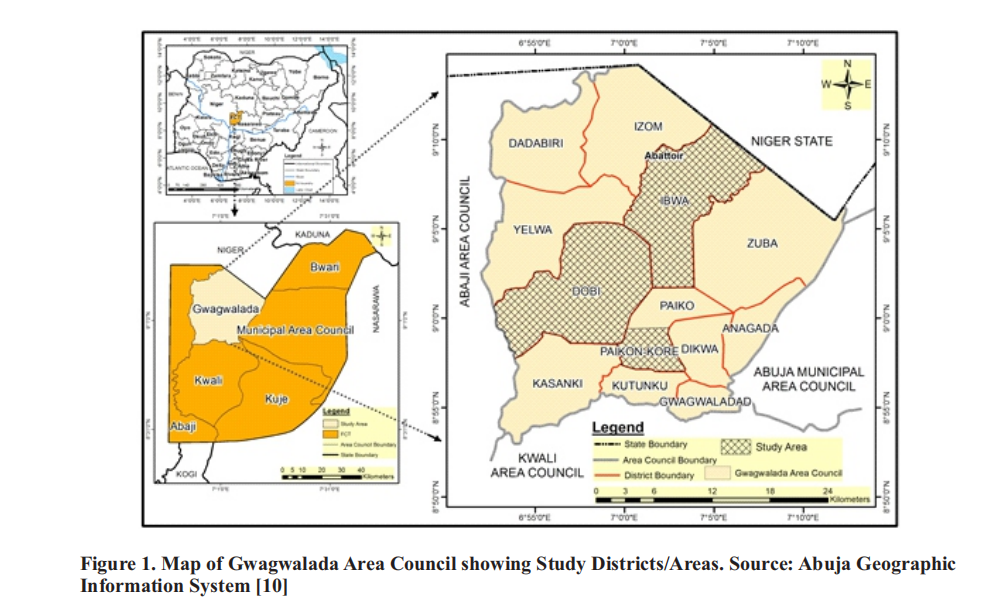
Hematophagous flies pose a high public health burden and are a nuisance to livestock and humans. Aprevalence study was conducted for species composition and distribution of hematophagous flies, as well as the occurrence of Trypanosoma species of livestock during the dry and wet seasons at Paikon-Kore, Dobi and Ibwa districts of Gwagwalada Area Council, Federal Capital Territory in 2016. Nzi and Biconical traps were used. Ten traps were placed for 48hrs in each of the three districts, and trapped flies were harvested after 48hrs in both seasons. Blood samples were collected from 243 livestock: cattle (174), sheep (38) and goats (31) respectively and analysed for the presence of haemoparasites using thick, thin blood smear and haematocrit centrifugation methods. A total of 560 flies were caught during the study. Paikon-Kore had a higher occurrence of flies 227(40.5%) than Dobi 140(25%) and Ibwa 193(34.5%) respectively. Stomoxys calcitrans was the highest occurrence in both wet season 341(78.8%) and dry season 81 (63.8%), respectively, followed by Musca domestica 79 (18.2%) for the wet season and 38(29.9%) for the dry season, while Glossina fly was 0(0.0%). The wet season had a higher number of trapped flies, 433, as compared to the dry season with 127. There was a significant association (p<0.05) between flies caught between districts and seasons. The livestock sampled showed a 2.5% prevalence of trypanosome infection. There was no significant association between the occurrence of Trypanosoma infection in the three districts. It is important to control or eradicate these hematophagous flies, which can serve as vectors in the transmission of pathogens which can cause significant health crises in livestock and humans
Article Details

This work is licensed under a Creative Commons Attribution-NonCommercial-NoDerivatives 4.0 International License.
References
Scmidtmann, E. T., Russek-Cohen, E., Morgan, O. N., Gernish, R. R., Wilson, D. D. & Gagnes, R. J. (1985). Su r v e y f o r a n e x o ti c mu s c o i d fl y. J o u r n a l o f Ec o n omi c En t omo l o g y , 7 8 , 6 : 1 3 2 0 - 1 3 2 2 . https://api.semanticscholar.org/CorpusID:83718925
Gruvel, J. (1980). General considerations on the significance of mechanical transmission of trypanosomes in livestock. International Journal of Tropical Insect Science, 1:55-57. doi: 10.1016/j.exppara.2003.12.014.
Buxton, P. A. (1955). The Natural History of Tsetse Flies: An Account of the Biology of the Genus Glossina (Diptera) School of Hygiene and Tropical Medicine. No. 10 H.K. Lewis, London. 55 – 203. https://catalog.nlm.nih.gov/discovery/fulldisplay/alma991442963406676/01NLM_INST:01NLM_INST
A non (2004). Af D B Se e k s t o E r a d i c a t e Ts e t s e . Pr e s s R e l e a s e ( N o . S E G L 3 /F/ / 043).https://kubanni.abu.edu.ng/bitstreams/af14ba99-a89a-4227-b45b-c1b587282593/download
Campbell, J. B., Skoda, S. R., Berkebile, D. R., Boxler, D. J., Thomas, G. D., Adams, D. C., & Davis, R. (2001). Effects of stable flies (Diptera: Muscidae) on weight gains of yearling cattle. Journal of Economic Entomology, 94(3): 780-783. https://doi.org/10.1603/0022-0493-94.3.780
Thrusfield, M. (1995). Sampling. In: Veterinary Epidemiology (2nd Ed), Blackwell Science Ltd., Oxford, 182- 198.
Askew, R.(1971). Parasitic Insects. London, England: Heinemann Educational Books Ltd. pp 276-295.
Carn, V. M. (1996). The Role of Dipterous Insects in the Mechanical Transmission of Animal Viruses. British Veterinary Journal, 152(4): 377-393. DOI: 10.1016/s0007-1935(96)80033-9
Li, X., Pace, T. & Zhong, D. (2019). Taxonomic review of Gasterosphilus (Oestridae, Gasterophilinae) of the world, with updated nomenclature, keys, biological notes and distributions. Zookeys, 891:119-156. doi: 10.3897/zookeys.891.38560.
Ibrahim, S., Ahmed, M. B., Usman, S. A. & Ahmed, Y. U. (2015). An overview of the functions of Abuja geographic information system (AGIS) as a tool for monitoring growth and development in Abuja, Nigeria (fcta.gov.ng); Journal of Environmental Science, Toxicology and Food Technology, 9(1):01-08. (IOSR-JESTFT) e-ISSN: 2319-2402, p-ISSN: 2319-2399.
National Population Commission (2006). National Population Commission (NPC) (2006) Nigerian Population Census Report. National Population Commission, Abuja, 21-27.
Omoogun, G.A., Dipeolu, O. O., & Akinboade, O. A.(1991). The decline of a Glossina morsitans submorsitans belt in the Egbe area of the derived savanna zone, Kwara State, Nigeria. Medical and Veterinary Entomology, 5: 43 – 50. https://doi.org/10.1111/j.1365-
2915.1991.tb00519.x
Ahmed, A. M., Abbas, H., Mansour, F.A., Gasim, G. I., & Adam, I. (2012). Schistosoma haematobium infections among school children in Central Sudan one year after treatment with praziquantel. Parasites and Vectors, 5: 108. doi: 10.1186/1756-3305-5-108.
Challier, A. & Laveissiere, C.(1973). Anew trap for catching tsetse flies (Glossina: Diptera, Muscidae) description and field trials. ORSTOM Notebooks. Medical Entomology and Parasitology Series, 11(4): 251-262. ISSN 0029-7224.
Murray, M., Murray, P. K., & McIntyre, W. I. M. (1977). An improved parasitological technique for the diagnosis of African trypanosomiasis. Transactions of the Royal Society of Tropical Medicine and Hygiene,71(4):325-326. https://pubmed.ncbi.nlm.nih.gov/563634/
Mungube, E. O., Diall, O., Baumann, M. P., Hoppenheit, A., Hinney, B., Bauer, B., Sanogo,Y., Maiga, B., Zessin, K. H., Randolph, T. F. & Clausen, P. H. (2012). Best-bet integrated strategies for containing drug-resistant trypanosomes in cattle. Parasites and Vectors, 5:164. doi: 10.1186/1756-3305-5-164.
Jegede, O. C., Mbuko, G., Obeta, S. S., Agbede, R. I. S., Ejiofor, C. E. & Daniels, T. (2015). Species composition and relative abundance of Insects of veterinary importance at Abuja, Nigeria. Nigerian Journal of Entomology, 31: 129-135. doi:36108/nje/5102/13.0122
Oluwafemi, R. A. (2008). Prevalence and distribution of Tsetse fly (mainly Glossina palpalis palpalis and Glossina tachinoides) in BICOT Project area in Lafia Local Government of Nassarawa State, Nigeria – Implication for sustainable Agricultural development.Environmental Science, Agricultural and Food Sciences, 4 (1):34-41.
de Raadt, P. (2002). “The First Millenia”. Historical Perspectives on African Trypanosomosis. http// wwwWuhmo.ox.ac.uk/docs/africantrypan abs.html.
Hadis, M., Endeshaw, T., Kebede, A., Asfaw, T. & Tilahun, T. (1995). Decline of Glossina morstians ugandensis in Gambella, Ethiopia. East African Medical Journal, 72 (6): 3635– 369. PMID: 7498005.
Berry, I. L. & Campbell, J. B. (1985). Time and weather effects on daily feeding pattern of stable flies (Diptera: Muscidae). Environmental Entomology, 14(3): 336-342. https://doi.org/10.1093/ee/14.3.336
Rogers, D. J. & Robinson, T. P. (2004). Tsetse distribution. In: Maudlin I, Holmes P, Miles M, editors. The Trypanosomiases. CAB International; Oxford: pp. 139–179.
Carn, V. M. (1996). The Role of Dipterous Insects in the Mechanical Transmission of Animal Viruses. British Veterinary Journal, 152(4): 377-393. DOI: 10.1016/s0007-1935(96)80033-9
Soulsby, E. J. L. (1982). Helminthes, Arthropods and Protozoa of Domesticated Animals. 7th edition. Bailliere Tindall and Cassell, London. 809. pp., Illus. 0-7020-0820-6. https://www.scirp.org/reference/referencespapers?referenceid=3264757
Chvala, M., Lyneborg, L. & Moucha, J. (1972). The horse flies of Europe (Diptera: Tabanidae). Entomological Society of Copenhagen. E. W. Classey Ltd., Hampton, 500pp. https://www.cabidigitallibrary.org/doi/full/10.5555/19732205451
Foil, L. D. (1989). Tabanids as vectors of disease agents. Parasitology Today, 5(3): 88-96. doi: 10. 1016/0169-4758(89)90009-4.
Ahmed, A. B., Okiwelu, S. N. & Samdi, S. M. (2005). Species diversity, abundance and seasonal occurrence of some biting flies in Southern Kaduna, Nigeria. African Journal of Biomedical Research, 8: 113-118. ISSN 1119-5096. doi: https://doi.org/10.4314/