

Knowledge, Attitude, and Practices of Rice Farmers and Pesticide Residue in Rice Agroecosystems of Anambra State, Nigeria: Implications for Mosquito Breeding Habitats
Article Sidebar
Main Article Content
Abstract
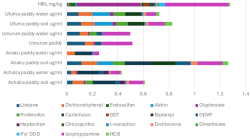
To develop effective strategies for reducing the adverse effects of pesticides on the environment and public health, it is essential to understandfarmers' knowledge, attitudes, and practices (KAP) regarding pesticide use, especially in rice agroecosystems. These areas are often overlooked when pest control strategies are planned, especially for mosquito control. This study aimed to survey the KAP of rice farmers, assess the relationship betweensociodemographic factors and KAP concerning insecticides used in the rice agroecosystem, and assess pesticide residues in rice paddies, considering their potential implications for mosquitobreeding habitats. The study was conducted among 394 farmers from four local government areas in Anambra State. The results showed that herbicides and insecticides were the most frequently used pesticides. Approximately 75% of the respondents had attended school and understood product labels. Licenced traders accounted for 76.6% of the total number of traders. Pesticide purchases accounted for 6% of total purchases, and storage mostly occurred at home. Most farmers hada fair amount of knowledge about the pesticides applied to their rice farms. Therewas no significant correlation between the farmers' knowledge of and attitude towards pesticide use. However, a significant relationship was found between farmers' knowledge and practices, with moderate strength. Additionally, farmers' attitudes towards pesticide use and their practices showed a weak negative correlation, which was statistically significant (Pearson's correlation test, P = 0. 002). Eighteen pesticide residues were detected in paddy water and soil samples, originating from a broad range of compounds, including insecticides and herbicides. Of the four major classes of insecticides, only three were detected:organochlorines, organophosphorus, and carbamates. The levels of detectedpesticide residues were compared to the Maximum Residue Limit (MRL) values for rice, with most residues in soil and water samples exceeding these limits. In rice farming, reducing soil pesticide levels through proper application techniques and implementing residue monitoring programmes isvital to ensure that residues remain within acceptable levels.
Article Details

This work is licensed under a Creative Commons Attribution-NonCommercial-NoDerivatives 4.0 International License.
References
1. Sabran, S. H., & Abas, A. (2021). Knowledge and Awareness on the Risks of Pesticide Use Among Farmers at Pulau Pinang, Malaysia. SAGE Open, 11(4). https://doi.org/10.1177/21582440211064894/ASSET/IMAGES/LARGE/10.1177_21582440211064894-FIG2.JPEG

2. Gianessi, L. P. (2014). Importance of Pesticides for Growing Rice in Sub-Saharan Africa | CropLife International. https://croplife.org/case-study/importance-of-pesticides-for-growing- ice-in-sub-saharan-africa/
3. Ng’ang’a, P. N., Shililu, J., Jayasinghe, G., Kimani, V., Kabutha, C., Kabuage, L., Kabiru, E., Githure, J., & Mutero, C. (2008). Malaria vector control practices in an irrigated rice agro-ecosystem in central Kenya and implications for malaria control. Malaria Journal, 7(1), 1–9. https://doi.org/10.1186/1475-2875-7-146/FIGURES/2
4. Dhakal, A., & Poudel, S. (2020). INTEGRATED PEST MANAGEMENT (IPM) AND ITSAPPLICATION IN RICE – A REVIEW. Reviews In Food And Agriculture, 1(2), 54–58. https://doi.org/10.26480/RFNA.02.2020.54.58
5. Padua, R. N., & Santos, R. G. (1998). Fundamentals of Educational Research and Data Analysis: Katha Publishing Co., Inc., 388 Quezon Avenue, Quezon City, Philippines, 37pp. https://books.google.com.ng/books?id=NwXMZ07Jp7UC&pg=PA35&dq=slovin%27s+formula&hl=en&sa=X&ved =2ahUKEwigibKfwonvAhUHkRQKHaxgBGwQ6AEwAHoECAAQAg#v=onepage&q&f=false
6. Chouaïbou, M. S., Fodjo, B. K., Fokou, G., Allassane, O. F., Koudou, B. G., David, J.-P., Antonio-Nkondjio, C., Ranson, H., & Bassirou, B. (2016). Influence of the agrochemicals used for rice and vegetable cultivation on insecticide resistance in malaria vectors in southern Côte d’Ivoire. Malaria Journal, 15(1), 426. https://doi.org/10.1186/s12936-016-1481-5
7. Heale, R., & Twycross, A. (2015). Validity and reliability in quantitative studies. Evidence-Based Nursing, 18(3), 66–67. https://doi.org/10.1136/b-2015-102129 8. Helrich, K. (Ed.). (1990). Official methods of analysis of the Association of Official Analytical Chemists (15th ed., Vols. 1-2). AOAC International.
9. European Union Pesticides Database—MRLs. (2022). https://ec.europa.eu/food/plant/pesticides/eu-pesticides- database/start/ creen/mrls
10. Al-zain, B. F., & Mosalami, J. (2011). Pesticides Usage, Perceptions, Practices and Health Effects among Farmers in North Gaza, Palestine. Indian Journal of Applied Research, 4(6), 17–22. https://doi.org/10.15373/2249555x/june2014/5
11. Okonya, J. S., & Kroschel, J. (2015). A Cross-Sectional Study of Pesticide Use and Knowledge of Smallholder Potato 321 Nigerian Journal of Parasitology Farmers in Uganda. BioMed Research International, 2015. https://doi.org/10.1155/2015/759049
12. Mekonnen, Y., & Agonafir, T. (2002). Pesticide sprayers’ knowledge, attitude, and practice of pesticide use on agricultural farms of Ethiopia. Occupational Medicine, 52(6), 311–315. https://doi.org/10.1093/occmed/52.6.311
13. Negatu, B., Kromhout, H., Mekonnen, Y., & Vermeulen, R. (2016). Use of Chemical Pesticides in Ethiopia: A Cross- Sectional Comparative Study on Knowledge, Attitude and Practice of Farmers and Farm Workers in Three Farming Systems. The Annals of Occupational Hygiene, 60(5), 551–566. https:// oi.org/10.1093/annhyg/mew004
14. Lekei, E. E., Ngowi, A. V., & London, L. (2014). Farmers’ knowledge, practices, and injuries associated with pesticide exposure in rural farming villages in Tanzania. BMC Public Health, 14(1), 1–13. https://doi.org/10.1186/1471-2458-14- 389
15. El-Saeid, M. H., & Selim, M. T. (2013). Multiresidue analysis of 86 pesticides using gas chromatography mass spectrometry: II-nonleafy vegetables. Journal of Chemistry, 2013. https://doi.org/10.1155/2013/727149
16. Chan, K., Tusting, L. S., Bottomley, C., Saito, K., Djouaka, R., & Lines, J. (2022). Malaria transmission and prevalence in rice-growing versus non-rice-growing villages in Africa: A systematic review and meta-analysis. The Lancet Planetary Health, 6(3), e257–e269. https://doi.org/10.1016/S2542-5196(21)00349-1
17. Mazigo, H. D., Mboera, L. E. G., Rumisha, S. F., & Kweka, E. J. (2019). Malaria mosquito control in rice paddy farms using biolarvicide mixed with fertiliser in Tanzania: Semi-field experiments. Malaria Journal, 18(1). https://doi.org/10.1186/S12936-019-2861-4
18. Alomar, A. A., & Alto, B. W. (2021). Mosquito responses to lethal and nonlethal effects of predation and an insect growth regulator. Ecosphere, 12(3), e03452. https://doi.org/10.1002/ECS2.3452
19. Demirak, M. Ş. Ş., & Canpolat, E. (2022). Plant-Based Bioinsecticides for Mosquito Control: Impact on Insecticide Resistance and Disease Transmission. Insects, 13(2). https://doi.org/ 0.3390/INSECTS13020162
20. Ambadiang, M. M., Fouet, C., Ashu, F. A., Penlap-Beng, V., & Kamdem, C. (2023). Chronic exposure of mosquito larvae to pesticide residues endangers a new generation of agrochemicals repurposed for malaria prevention. https://doi.org/10.1101/2023.04.18.537423
21. Disi, J. O., Van Timmeren, S., Gress, B., Zalom, F., Isaacs, R., & Sial, A. (2020). Insecticide residue longevity for on- site screening of Drosophila suzukii (Matsumura) resistance. Pest Management Science, 76(9), 2918–2924. https://doi.org/10.1002/ps.5880
22. Swale, D. R., Carlier, P. R., Hartsel, J. A., Ma, M., & Bloomquist, J. R. (2015). Mosquitocidal carbamates with low toxicity to agricultural pests: An advantageous property for insecticide resistance management. Pest Management Science, 71(8), 1158–1164. https://doi.org/10.1002/ps.3899
23. Damalas, C. A., & Eleftherohorinos, I. G. (2011). Pesticide Exposure, Safety Issues, and Risk Assessment Indicators. International Journal of Environmental Research and Public Health, 8(5), 1402. https://doi.org/10.3390/IJERPH8051402