

Antibiotic Resistance Patterns in Bacterial Pathogens Isolated from African Catfish (<i>Clarias gariepinus</i>) sold in Calabar Markets, Nigeria
Article Sidebar
Main Article Content
Abstract
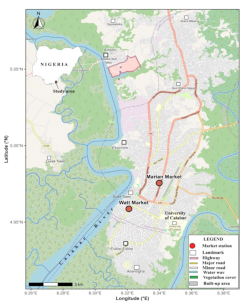
Antimicrobial resistance in foodborne pathogens poses a growing threat, particularly in developing countries with expanding aquaculture. This study examined antibiotic resistance in bacteria isolated from African catfish (Clarias gariepinus) sold in two major wet markets (Watt and Marian) in Calabar, Nigeria. Eighteen samples (fresh and dried) were analysed, with bacteria isolated from the gills, skin, and intestines, and then tested against 12 antibiotics using the disk-diffusion method. Contamination was heavily influenced by market location and preservation state: Watt Market and all fresh samples exhibited a 100% contamination rate, compared to 55.6% for Marian Market and dried samples. Organ-wise analysis showed that the intestine harboured the highest pathogen load (38.9%), followed by the skin (33.3%) and gills (22.2%). Staphylococcus aureus (35.3%), Aeromonas spp. (29.4%), and Pseudomonas aeruginosa (23.5%) were the most common isolates. P. aeruginosa showed complete resistance to ampicillin and augmentin, yielding the highest Multiple Antibiotic Resistance (MAR) indices (up to 0.67). Principal Component Analysis (PCA) of zones of inhibition successfully reduced the dimensionality of the dataset, revealing clear species-specific resistance clusters driven by distinct β-lactam and quinolonesusceptibility profiles. The high prevalence of multidrug-resistant isolates highlights the acute public health risk of food chain transmission. Immediate improvements in wet market hygiene protocols and strict regional antibiotic use are strongly recommended.
Article Details

This work is licensed under a Creative Commons Attribution-NonCommercial-NoDerivatives 4.0 International License.
References
1. Ogunji, J., & Wuertz, S. (2023). Aquaculture Development in Nigeria: The Second Biggest Aquaculture Producer in Africa. Water, 15(24), 4224. https://doi.org/10.3390/w15244224
2. Muringai, R. T., & Musakwa, W. (2025). Analysis of aquaculture methods, socio-economic benefits, and challenges faced by small-scale fish farmers in Chiredzi Rural District, Zimbabwe. Scientific African, 31, e03128. https://doi.org/10.1016/j.sciaf.2025.e03128
3. Irabor, A. E., Yossa, R., Fatan, N. A., Owen, M. A. G., Norouzitallab, P., Baruah, K., & Dimitroglou, A. (2026). The Quest for Functional Ingredients for Sustainable Aquaculture Feeds in Sub-Saharan Africa. Aquaculture nutrition, 2026, 9937988. https://doi.org/10.1155/anu/9937988
4. Olorunshola, M. M., Agidigbi, T. S., & Adeniyi, B. A. (2025). Antimicrobial activity of lactic acid bacteria isolatedfrom the gut of African catfish (Clarias gariepinus) against multidrug-resistant resident pathogens. BMC Microbiology,25(1), 410. https://doi.org/10.1186/s12866-025-04139-5
5. Oluranti, O. O., Ubanagu, C. I., Oluwasemowo, O. O., Akinola, O. T., Nejo, Y. T., & Motayo, B. O. (2019). Prevalence and antibiotic resistance profile of Pseudomonas aeruginosa from hospital sinks in South Western Nigeria. Journal of Advances in Medicine and Medical Research, 29(2), 1–7.https://doi.org/10.9734/jammr/2019/v29i230067
6. Agbabiaka, L. A., Onwuzuruigbo, F. O., & Jimoh, O. A. (2025). Threat to fish food safety in Nigeria: Role of antimicrobial usage and resistance in aquaculture. Aquaculture Reports, 40, 102643. https://doi.org/10.1016/j.aqrep.2025.102643
7.Okafor, C. O. O., Iroha, I. R., Ude, I. U., Onuoha, S. C., Ejikeugwu, C., Ovia, K. N., Eromonsele, B. O., Agah, V. M., Okoronkwo, C., Gabriel- beh, I., Okoroafor, I., & Nwachukwu, O. B. (2022). Drug resistance profile of biofilm forming Pseudomonas aeruginosa isolated from aquatic environment in South Eastern Nigeria. Environmental Challenges, 8, 100530. https://doi.org/10.1016/j.envc.2022.100530
8. Nwankwo, C. G., Ikeogu, C.F., Okeke, P. A., Ikechukwu, C. C., & Okpala Ezennia, K. P. (2025). Prevalence ofantibiotic resistant bacteria isolated from cultured and wild Clarias gariepinus in Awka, Nigeria. Agriculture, Food, and Natural Resources Journal, 4(1), 197–203. https://doi.org/10.5281/zenodo.15115340
9. Wubie, A., Dagne, A., Tesfaye, G., Tesfaye, G., & Tadese, D. A. (2023). Reproductive biology and condition factor of the African catfish, Clarias gariepinus (Burchell 1822) in Lake Koka, Ethiopia. Journal of Fisheries, 11(2), 112203.https://doi.org/10.17017/j.fish.442
10. Adesoji, A. T., Onuh, J. P., Musa, A. O., & Akinrosoye, P. F. (2019). Bacteriological quality and antibiogram study of bacteria from “suya” and smoked fish (Clarias gariepinus) in Dutsin-Ma, Katsina State, Nigeria. Pan African Medical Journal, 33(219), 1–9. https://doi.org/10.11604/pamj.2019.33.219.17729
11. Du Sert, N. P., Ahluwalia, A., Alam, S., Avey, M. T., Baker, M., Browne, W. J., Clark, A., Cuthill, I. C., Dirnagl, U., Emerson, M., Garner, P., Holgate, S. T., Howells, D. W., Hurst, V., Karp, N. A., Lazic, S. E., Lidster, K., MacCallum, C. J., Macleod, M., . . . Würbel, H. (2020). Reporting animal research: Explanation and elaboration for the ARRIVE guidelines 2.0. PLoS Biology, 18(7), e3000411. https://doi.org/10.1371/journal.pbio.000411
12. Usman, M., Wakawa, A., Musa, A., Ahmad, K., & Isiaku, A. (2021). Occurrence of multi-drug resistant Enterobacteriaceae in cultured Clarias gariepinus (African catfish) in Kano metropolis, Nigeria. Sokoto Journal of Veterinary Sciences, 19(2), 106–111. https://doi.org/10.4314/okjvs.v19i2.5
13. Imade, O., & Akinnibosun, F. (2018). The Nigerian catfish (Clarias gariepinus) pisciculture systems: reservoirs of multidrug- resistant bacteria. Journal of Applied Microbiology, 125(5), 1552–1568. https://doi.org/10.1111/jam.14056
14. Al-Dhabaan F. A. (2019).Morphological, biochemical and molecular identification of petroleum hydrocarbons biodegradation bacteria isolated from oil polluted soil in Dhahran, Saudi Arabia. Saudi journal of biological sciences, 26(6), 1247–1252. https://doi.org/10.1016/j.sjbs.2018.05.029
15. Coker, M. E., Oaikhena, A. O., &Ajayi, T. O. (2021). Antimicrobial activity of extracts and fractions of Euphorbia lateriflora (Schum. and Thonn) on microbial isolates of the urinary tract. Saudi Journal of Biological Sciences, 28(8), 4723–4731. https://doi.org/10.1016/j.sjbs.2021.04.086
16. Barrera Patiño, C. P., Bonner,M., Borsatto, A. R., Soares, J. M., Blanco, K. C., & Bagnato, V. S. (2025). Time Evolution of Bacterial Resistance Observed with Principal Component Analysis. Antibiotics (Basel, Switzerland), 14(7), 729. https://doi.org/10.3390/antibiotics14070729
17. Mitiku, B. A., Mitiku, M. A., Ayalew, G. G., Alemu, H. Y., Geremew, U. M., & Wubayehu, M. T. (2022). Microbiological quality assessment of fish origin food along the production chain in Upper Blue Nile watershed, Ethiopia. Food science & nutrition, 11(2), 1096–1103. https://doi.org/10.1002/fsn3.3147
18. Matouke, M., & Nour, K. (2019). Characterisation of antibiotic-resistant Staphylococcus aureus from gills and gastro- intestinal tracts of catfish (Clarias gariepinus) and water samples from Jabi Lake, Abuja, Nigeria. African Journal of Clinical and Experimental Microbiology, 20(3), 231. https://doi.org/10.4314/ jcem.v20i3.8
19. Mukaro, P., Nhiwatiwa, T., & Manjengwa, F. (2016). An investigation of the microbiological chain of contaminationand health implications of fish products from Lake Chivero, Harare, Zimbabwe. International Journal of Postharvest Technology and Innovation, 5(3), 215. https://doi.org/10.1504/ijpti.2016.10004634
20. Adah, D. A., Sa’idu, L., & Oniye, S. J. (2023). Occurrence of Aeromonas spp. resistant to some selected antibiotics isolated from farmed Clarias gariepinus. Journal of Applied Veterinary Science and Technology, 4(1), 24– 9. https://doi.org/10.20473/javest.v4.i1.2023.24-29
21. Onuoha, S. C., & Nweke, R. N. (2024). Antibiotic-resistant Pseudomonas aeruginosa from abattoir and aquaculture environment in Abakaliki, Ebonyi State, southeast Nigeria. African Journal of Clinical and Experimental Microbiology, 26(1), 39–47. https://doi.org/10.4314/ajcem.v26i1.6